
The Big Trip


Acclimation and Decompression part 1

The suitcases are back in the attic, and the maps and guidebooks have been stowed back in the bookcase. This last activity took a bit of time because the floor to ceiling double bookcase in our living room is totally jammed with other maps and guides that needed culling before I could possibly squeeze another thing in there. What struck me as I poked around for space on these crowded shelves was how incredibly fortunate we have been to enjoy the road map of travel, both dreamed of and realized, that this collection described.

Some choices were easy: “Hiking Trails of Mt St Helen” – out. “Wilderness Camping With Children” – definitely out. No library in its right mind would consider accepting a donation of the Word Atlas that Sam received as a bar mitzvah gift in 1995, but perhaps they would be interested in a first edition of “Chowing Down The Strip; A Field Guide to the Restaurants of Las Vegas.” There were books that must have been left by strangers stealing into our house at night desperate to rid their own sagging shelves of surplus travel books: “Say It In Swahili” and “The Rough Guide to Mongolia” were certainly not my purchases. Then there were books that, just seeing the title on the spine, brought back such heart-happy memories: “Paris Walks”, “Frommer’s Guide to Capri” and “The Vietnamese Phrase Book” (not that I ever actually said anything in Vietnamese). The 1969 Blue Guide to Morocco is almost as old as our marriage and while it may be a bit out of date, just seeing it there reminds me that, thanks to Crosby Stills and Nash, we were, once upon a time, inspired to take a trip because of a song.

Books I loved about places I once assumed we would only visit by proxy including Stuart Steven’s “Malaria Dreams” and Mark Salzman’s “Iron and Silk” will remain part of the permanent collection. My travel journals overstuffed with mementos and cards recall meals and hotels I will never forget as well as meals and hotels that deserved to be immediately forgotten (but linger on in memory to be trotted out whenever people share their travel horror stories). There is a whole section (well, ‘section’ implies that there is some order to the books on these shelves – trust me, there is not – perhaps ‘collection’ is a better word), I think of as ‘inspirational’ books. No, not the “Complete Guide to Walking the Camino Compostela Santiago,” (out). I mean books that one of us purchased in hope and/or expectation, however misguided, of trips that were simply waiting for the right time, the right place and the right bank account to happen. A quartet of still pristine Lonely Planet Guides: Cuba, Sri Lanka, Bhutan, and Sicily with their shiny covers and stiff spines were keeping each other company. Hopefully someday we will be able to put an end to their loneliness and take them along on a trip.

It’s easy to tell which books have logged miles and which are waiting on ‘standby.’ Dogeared pages alternating with yellow Post-its covered with David’s neat writing or my illegible chicken scratching are the telltale signs. Open these books and admission tickets to places like Kartchner Cavern State Park and The titan Missile Museum flutter out of guides to southern Arizona and site maps of Pompeii are glued by dried drips of gianduja gelato to a menu from a tiny roadside cafe in Naples.

There is absolutely no organization to the books, although I keep promising myself that someday I will create some sort of order. Right now though if someone wanted to know the name of that fabulous trattoria in Venice where we had the pasta with squid ink I’d raved about I would first have to locate the guide book we took to Venice which could be anywhere, but was in fact sandwiched in between “Hawaii Access” and “Taming Alaska: An RV Odyssey.” Then I’d have to leaf through the book to find the place that listed two restaurants that served pasta with squid ink sauce. An emphatically ‘THIS’ not ‘THAT’ ‘ indicating which was which.

A good number of our books have taken multiple journeys in suitcases and backpacks other than ours. They’ve traveled in the company of family members, friends, and friends of friends who have taken them along on trips of their own. I always request that the borrowers jot down notes of their own or tuck into the pages business cards or brochures that then expand the reach of the printed page. A solid thumbs up or thumbs down by someone who has actually experienced a place goes a long way in smoothing the road for the next traveler. If you are planning a trip, please visit these shelves before you visit Amazon (the website, not the river).

A large part of the pleasure of this last journey was the chance to write about it. The writers’ block that had laid me low these past few years has somehow moved off shore leaving me finally able to express myself in print again. The chance to share it with you and get your feedback gave me great pleasure. I am determined to make the most of that reunion of thought and voice, and certain that the inspiration for another trip lies in the helter-skelter traffic jam of volumes here. Meanwhile, back to the task at hand.

20130508-185531.jpg

Musings

“What country?” Is the question most asked of us by everyone from our waiter brining us the steaming basket of butter nan, to the adolescent boys we pass on the street, and people we meet at the usual sightseeing places. We used to answer US, but now I just smile and say, “Obama!” Everyone gets it. Everyone we’ve met loves him as much as we do.

Perhaps it’s that we’ve traveled off season, or to unusually remote places, but more often than not we are the only westerners in sight. The next question inevitably the next question is, “picture?” This does not mean they want us to take their picture, it means they want to have their picture taken with us. David is a good sport about it, I usually mention that I’m in the witness protection program.

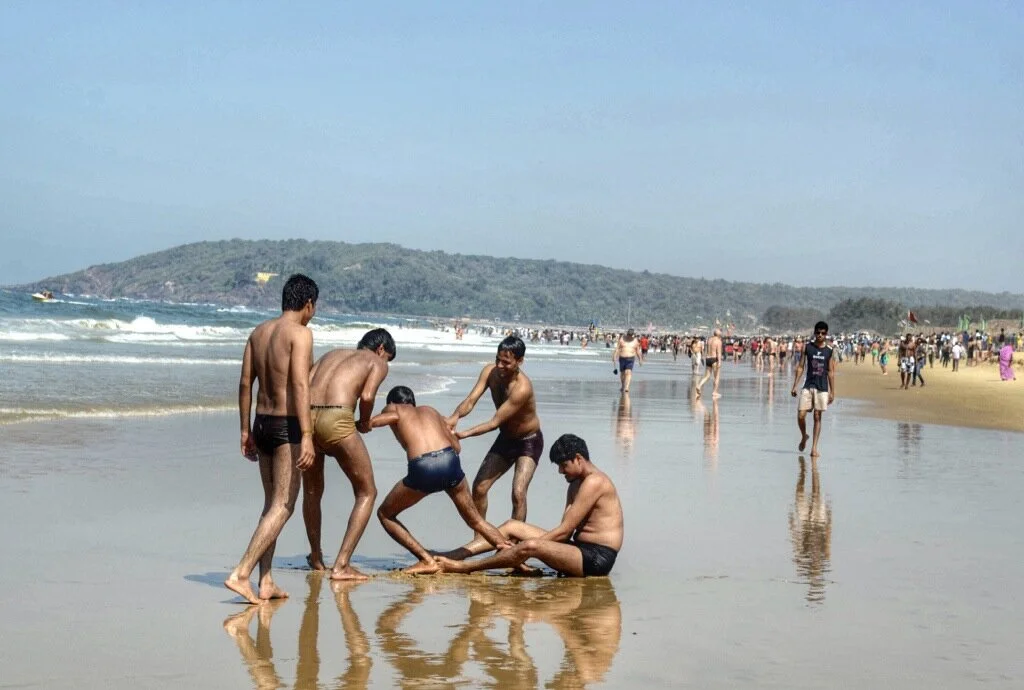
I’m writing this post from home. It seems so weird that 36 hours ago I was standing at the edge of the Arabian Sea where a bunch of guys were doing astonishing things with a soccer ball.

20130404-105340.jpg
…and now I’m trying to sort through almost four months of mail.
We returned yesterday afternoon. Suitcases are mostly unpacked. The laundry is piled up ready to be dealt with. I’m trying to remember which gift is meant for which person. (Who did I promise this to?)

20130404-105701.jpg
The refrigerator is empty and we need to do some food shopping. I guess David was serious about retirement because he hasn’t talked about going to the office.
Instead of running around taking care of any of these things I am sitting here writing. That this blog has run its course, makes me almost as sad as having the trip come to an end. After the initial frustration and negotiation with the learning curve, I have came to enjoy writing it very much. It was great to have David weight in when he had something to say (having nothing to say never held me back). I am playing with the thought of continuing it on another subject and a soon as I find one that might remotely be of interest to anyone but me, I’ll throw it out there and wait for your feedback. I still have photos I want to post, so we won’t be be totally out of your lives. I am so grateful to you for reading the blog. Your comments and feedback created such an important connection to home for both of us.

For right now take good care and remember that’s there’s a whole, huge world out there, ready for your exploration and enjoyment.

20130404-104525.jpg

Lora

The Long and Winding Road

David: We’ve mentioned the amazing roads around the hill stations, but the road from Mandi to Shimla is worthy of special mention. It is of the same nature as the roads to Dharamsala and Manali, but it is longer, steeper, and has more hairpin turns than the others. And unlike the others, the road to Shimla is a major truck route. Driving it gives a small sense of what it must be like going over the Khyber Pass with all the military supply convoys heading for Afghanistan. An unending stream of overloaded lorries laboring to get up the mountains and then down the other side. On the way up there are many stretches where the lorries struggle to keep pace with a person strolling leisurely along the roadside. And on the way down, their brakes are a constant shriek of metal-on-metal as the drivers try to hold the speed back as they negotiate the succession steeply descending hairpin turns.

Mixed in with all the lorries are busses, cars, vans, motorcycles and motor scooters that want to pass the lorries, and each other, at will. There seem to be two rules of the road for passing. If you do not see any approaching traffic (even when you are entering a blind hairpin curve), it’s ok to pass because the road ahead is clear. And if you do see oncoming traffic, it’s ok to pass because the approaching driver sees you and knows what kind of evasive action is needed to survive the encounter. All this with an almost vertical drop of 1,000 feet if you misjudge where your tire hits the road. As our son Max observed when he first visited India 20 years ago, all the drivers are good because all the bad drivers are dead.

The lorries themselves offer a visual treat. Many are the British lorries of World War II design that the Indians continue to produce, and some are slight updates of those old designs. It is as though time has been frozen over the past 60-70 years. Also, the lorries have exuberant personalities created by the over-the-top idiosyncratic artwork that covers them. Photos are the only way to describe their appearance.

The only hairpin turns we have seen more severe than those on the road to Shimla are those on the road going up to the monkey temple that sits on the highest peak overlooking the town. The only way to negotiate the turns at each end of the many switchbacks on that road is to make one, and sometimes even two, three-point turns.

The road down from Shimla to Chandigarh, where we caught a plane to start our flight home, is more of the same with one difference (“same, same, but different” as they say in Luang Prabang); the change in elevation is even more severe because Chandigarh is all the way back down in the plains. A parting phenomenon before leaving the mountains was the Timber Trail Resort. You have to picture this from words because it is impossible to capture an adequate image by camera. The road runs the length of a narrow valley, half-way up an extremely steep mountainside that must rise no less than 1,500 feet above the river. On top of the opposing mountainside is the Timber Trail Resort, which guests access by cable car that soars, in a single span, high across the river from the road to the resort. They are building a road on the opposing mountainside to provide better access to the resort, and the construction has created a non-stop rockslide from the top of the mountain to the river. We stopped to watch and wonder, how did they build the hotel in that impossible location, and why.
20130403-013851.jpg
20130403-013940.jpg
20130403-014010.jpg
20130403-014027.jpg
20130403-082819.jpg
Lora: in addition to the hairpin turns and ‘hold your breath and pray’ driving styles, there are other constants. Namely tea stalls. Indian people like to eat and they make sure there’s always food available. Thus, even in the most remote or unexpected place you will find small shacks where you can buy, in addition to tea (chai), candy bars, packaged cookies, fruit and cigarettes. Typically there are groups of men standing or lounging around, shooting the breeze. You never see women there – our guess is hat they are working. You can find these stalls in the most ridiculously remote locations – at the top of a mountain,for instance, or down in a dusty valley village. They are adjacent to a temple and shrines, and as you enter and exist monuments, parks and national monuments. We developed a taste for small packages of Oreos (fewer bad ingredients when the come in small packages, I am certain) and Cabury fruit and nut bars.

20130404-101100.jpg
Food carts are as ubiquitous as the black crows that hang out waiting for someone to drop a morsel of anything edible. To score a whole momo (fried vegetable filled savory pastry) is a very big deal.

20130404-101546.jpg

20130404-101602.jpg
There are even sources of nourishment that have you staring in wonder:

20130404-101713.jpg

Homeward Bound: Chandigarh – Mumbai – London – Boston and our friend Ellen Grossman

20130402-154249.jpg
Dear Friends and faithful readers,

We are are in Mumbai for night, waiting for our early morning flight nome and I am thinking about stuff. I foresee only a couple more posts after this one – notably our drive yesterday from Shimla to Chandigarh – , as we are on our way back home. I need to sort through the thousands of images both on media cards and on almost 30 rolls of 120 film waiting to be developed, Then I’ll know whether or not I was able to make 12 images that I can be proud of. Or was it 10, or 8?

So often on this trip we were reminded how incredibly lucky we are to be able to realize this dream of extended, slow travel, taking almost four months together to explore places in both Southeast Asia and India (and of course Taiwan as well).

The most heartbreaking reminder to follow your dream, not just dream about following your dream, arrived via email last night when we received word that our friend Ellen Grossman had died. Seeing the words ‘died’ and ‘Ellen’ in the same sentence was totally inconceivable to us. Then the flood of emails began to arrive from people on the Cape and in Boston confirming the news that Ellen had died on Sunday night.

We saw Ellen and Rick in Provincetown in early October. She looked as vibrant and energetic and, of course beautiful, as always. Over dinner the four of us talked about our upcoming trip – especially about what kind of photo equipment I should bring along. Seeing her that evening lighting up the room in her inimitable way, it’s impossible to imagine that she would receive a diagnosis of cancer shortly thereafter and then die only 4 months later, leaving Rick, their children and extended family and friends totally devastated.

I can’t help thinking that it was almost a year ago to the day that our mutual friend Judy Salzman died suddenly. Rick and Ellen took tender care of her husband Carl during this terrible time, supporting him emotionally and (knowing Ellen) culinarily, in their typical loving way. I can imagine that now those roles are reversed with Carl (battle-scared as he is) helping his friend Rick and his children through the same sad passage.

In one of the emails I received last night from Ellen and Rick’s daughter Erica, was this advice:

“Life is short don’t waste it on the unimportant stuff!! Hug your family, tell them you love them…and eat dessert first because you never know what the next minute will bring!” Ellen never wasted a minute on the unimportant stuff, and I distinctly remember when we sat down for dinner that night at Devon her asking to see the dessert menu before ordering an entrée. We’re on our way home to hug our family and hope there are some good desserts to eat. And then to plan the next adventure.

By the way those flowers are growing in someone’s garden on the road from Shimla to Chandigarh.

Stoned! The Charndagarh Rock Garden

We have forgiven American Airlines for not letting us add a long stop over in London to our around-the-world tickets. We had thoughts of going to Cyprus – not such a good place to be right now it turns out. Our only choices were to either spend the last month of our trip in India, or go home early. Luckily we chose ‘stay’ not ‘go’ which is how we found ourselves visiting hill stations in the north as well as having an extra day to spend in Chandagarh, an almost brand new modern city created right after Partition and designed by world famous architects such as Le Corbusier and Maxwell Fry. We visited the stunning High Court Building (sorry, no photos allowed) usually closed to visitors but fortunate David had a business card which identified him as an attorney, so,we were allowed inside to stare opened mouthed at the soaring inner space made entirely of poured concrete. The building (designed by Le Corbusier) has stood the test of time and remains a stunning master piece of modern architecture.

Our very favorite visit, however was to the Rock Garden created by Nek Chand. It practically defies description. And the pictures I took (see below) hardly do it justice. Because I was totally enchanted with the small figures modeled from spare parts I spent time taking pictures of just a few of the 1,600 on view in the park.

Wikipedia says it better than I ever could:
The Rock Garden of Chandigarh is a Sculpture garden in Chandigarh, India, also known as Nek Chand’s Rock Garden after its founder Nek Chand, a government official who started the garden secretly in his spare time in 1957. Today it is spread over an area of forty-acres (160,000 m²), it is completely built of industrial & home waste and thrown-away items.

The garden is most famous for its sculptures made from recycled ceramic and completely built of industrial & home waste and thrown-away items.

Waterfall at Rock Garden, Chandigarh
It is situated near Sukhna Lake. It consists of man-made interlinked waterfalls and many other sculptures that have been made of scrap & other kinds of wastes (bottles, glasses, bangles, tiles, ceramic pots, sinks, electrical waste, etc.) which are placed in walled paths.
In his spare time, Chand began collecting materials from demolition sites around the city. He recycled these materials into his own vision of the divine kingdom of Sukrani, choosing a gorge in a forest near Sukhna Lake for his work. The gorge had been designated as a land conservancy, a forest buffer established in 1902 that nothing could be built on. Chand’s work was illegal, but he was able to hide it for eighteen years before it was discovered by the authorities in 1975. By this time, it had grown into a 12-acre (49,000 m2) complex of interlinked courtyards, each filled with hundreds of pottery-covered concrete sculptures of dancers, musicians, and animals.

His work was in serious danger of being demolished, but he was able to get public opinion on his side, and in 1976 the park was inaugurated as a public space. Nek Chand was given a salary, a title (“Sub-Divisional Engineer, Rock Garden”), and a workforce of 50 laborers so that he could concentrate full-time on his work. It even appeared on an Indian stamp in 1983.The Rock Garden is still made out of recycled materials; and with the government’s help, Chand was able to set up collection centers around the city for waste, especially rags and broken ceramics.

When Chand left the country on a lecture tour in 1996, the city withdrew its funding, and vandals attacked the park. The Rock Garden Society took over the administration and upkeep of this unique visionary environment.

The garden is visited by over five thousand people daily, with a total of more than twelve million visitors since its inception.

20130402-013812.jpg

20130402-013841.jpg

20130402-013919.jpg

20130402-013941.jpg

20130402-014003.jpg

20130402-014032.jpg

20130402-014105.jpg

20130402-014513.jpg

20130402-021106.jpg

20130402-021206.jpg

Shimla – A Vertical Barrel of Monkeys

Shimla, the hill station capital of the Indian state of Hamachel Pradesh, was established in 1864 as the summer seat of the British ruling power. The details and signing of Partition took place here in a magnificent building that now houses The India Institute of Advanced Study where scholars do research on the humanities and Social Sciences.
India Institute of Advanced Studies

20130331-221508.jpg
Shimla is the most vertical city either of us has ever seen. David announced it was a grade even steeper than Darjeeling where one misstep meant you wouldn’t have to worry about what was for lunch ever again. This city’s fire department has a few non-traditional pieces of equipment that can navigate narrow lanes and steep inclines:

20130331-225859.jpg
Row upon row of buildings perch on terraced hillsides one above the other. The climb from bottom to top os so steep that there is actually a series of elevators that deliver you halfway up. These pictures don’t begin to do it justice. You’ll have to use your imagination as well.

20130331-221939.jpg

20130331-222231.jpg
This is a place where rhododendrons grow into 30 foot trees, and monkeys are everywhere. These are animals that demand their personal space (approaching them or staring them in the eye is asking for trouble), but are happy to invade yours if you have something they want. Particularly something shiny. While you can see them everywhere in town:

20130331-223211.jpg
The most outstanding place to see them is at The Monkey Temple which is perched on the very top of the highest peak in town. The road up is narrow and rocky and barely one car wide. Gurjeet, our trusty driver grew up in this town and handled the incredibly steep drive up with his usual patience and skill. I tried not to look out the window to see how close to the edge of the precipice we were, or how close to the car going the opposite way. If you think you’ve seen hairpin turns and haven’t been to Shimla, then you actually haven’t seen hairpin turns.

Arriving at the top of the peak Gurjeet cautioned us to leave our glasses in the car and to rent two stout sticks for protection.

We had spotted the monkey statue from down in town. It dominates the peak and its neon orange color is a little hard to miss. Up close, however, it is mind blowingly gigantic.

20130331-224528.jpg
As it was a Sunday afternoon crowds of people had gathered at the temple for the free lunch that is served to anyone who would like to join the communal meal. We stood outside the hall where people were eating, and watched the monkeys trying to sneak in, then running off to play when it was clear there wouldn’t be any handouts.

20130331-224935.jpg
This particular monkey had grabbed a woman’s shawl, attracted, I guess buy the edging of sequins.

He held onto it, stroking the fabric, like a baby does with a favorite stuffed animal. In time a young man threw a packet of peanuts at the monkey who briefly dropped the shawl in favor of food. As soon as the young man grabbed the shawl and started to run the monkey forgot the peanuts and gave chace. This is where those rented sticks come in handy.

20130331-225401.jpg
I have to admit, some of those monkeys are adorable: especially when they are still babies. I’ve hardly even seen anyone have quite as much fun. Click this link to see true monkey business:
Monkeys at play

20130331-225517.jpg
While some of them are downright nasty when threatened – particular by someone taking photos.

20130331-225727.jpg
Tomorrow (Monday) morning we leave for Chandagar for a day in India’s most modern city, and then on Tuesday we fly to Mumbai to catch our flight home through London.
David says he knows he’s ready to go home because he’s lost the desire to do research on the places we are visiting. I think I’m just about ready to stop being a tourist. More on that later.

Solang Pass

There are stunning views of snow capped mountains in every direction in Manali. Why we thought that getting an even better up close and personal view of snow would be a good idea remains a mystery. But our driver said we should go up to “snow point”, an hour north of Manali. The road turned out to be an order of magnitude worse than the road that we used to get to Manali from Mandi. Boulders were on the road from innumerable rockslides, several sections of the road had washed out, the potholes could (and did) break axles, and one-lane sections had to accommodate both directions of travel. In spite of these conditions, we found ourselves in a lemming-like convoy of tourist busses, vans and cars. We knew it was going to be a less-than-ideal experience when we reached the first of the infinite number of shanties lining both sides of the road offering “for hire” full body ski suits, rubber boots, vintage skis, and full length winter coats that looked like they were made of synthetic yak wool and weighed 100 pounds each. In front of each shanty was a hand-painted sign that read “Shop No. 341” or “Shop No. 749” etc. And each item “for hire” prominently displayed the number of the shop that had put it out “for hire”.

The cars, vans and busses reached a point of gridlock about half a mile short of the final destination. Everyone then continued on foot through the slush, lemming-style,including the women in high heels. With very few exceptions, the tourists were from other parts of India, and it appeared that most of them had never seen snow before. It was a circus-like atmosphere at the end of the road that words cannot describe, and that we fled after just a few minutes. Luckily our driver was able to extricate our car from the gridlock and we made our escape. Just in time, we discovered the next morning. A short while after we left, a major rockslide blocked the road and stranded everyone else up on the mountain for more than 4 or 5 hours.

20130330-232333.jpg

20130330-232405.jpg

20130330-232453.jpg

20130330-232517.jpg

20130330-232535.jpg

20130330-232625.jpg

Trek To The Waterfall

I always had envisioned trekking as activity reserved for people who do triathlons, or run up and down Mt Everest in an afternoon. Here in India trekking means a walk in the woods and that’s how we found ourselves one fine spring afternoon strolling through a nearby and most charming village, past the hot springs and up a gently winding path toward a waterfall.

The path to the waterfall goes through a little village built on a steep hillside. The village probably got its genesis from the hot spring and adjacent temple located in its center. Now it’s got its fair share of a multinational mix of cafes and tea stalls as well as an aging hippie or two. Eating well and continuously is an activity strongly aligned with trekking. Puppies and new born calves wandered about and children played a game the consisted of throwing a ball and knocking the top of small piles of stones. Women walked by carrying loads of firewood on their backs.

Beyond the village center, where the road ends, there are only narrow winding alleys with houses squeezed onto concrete terraces up and down the hillside. There are no open fields because of the very steep slope of the hillside. Therefore, each family’s cows simply live on the concrete terrace outside the family’s front door. As often as not, that concrete terrace on which the cows live also serves as the roof of the house on terrace below. All the concrete, rebars, gravel and other construction materials get carried to the construction sites on the backs of the villagers, both men and women. And all the cow manure gets removed from the village the same way.

There was always something interesting to look at as we made our way first through narrow streets, down mossy trails set next to meadows and then in the woods until the towering falls came into view. Apple and cherry trees were in bloom and bougainvillea flowed over many of the old concrete dwellings. Spring was in the air which put a spring into our step until David decided a nap was in order.

20130330-223028.jpg

20130330-223116.jpg

20130330-223208.jpg

20130330-223902.jpg

20130330-223331.jpg

<code></code>20130330-224110.jpg

20130330-224010.jpg

20130330-223659.jpg

20130330-223723.jpg

20130330-231510.jpg

Mandi to Manali

The weather report predicted heavy downpours plus thunder and lightening. Since driving (in this case being driven) on those dangerous roads even in dry weather was not my favorite activity we opted to leave McLeodganj a day early and drive the 6 hours to Mandi well before the rains came. We acknowledged that this would mean spending three nights instead of two in a town that barely made it into any of our guide books. We chose to stop there to avoid a 10 hour drive to Manali. Anyway, we figured, how bad could a hotel that called itself a resort and was the number one pick on Trip Advisor be? We could spend two days of predicted bad weather reading and updating the blog.
20130326-064608.jpg
In reality the Munish Resort in Mandi wasn’t exactly how it had been hyped on its website. And all those positive comments pushing it to into first place? Perhaps many family members were instructed to sing its praises. Who knows. Lets just say that the third strike was a totally inedible meal of foods taken directly from the freezer and deposited in the deep fryer. Having to stand outside the hotel in the rain to get a wifi connection was number two, and the fact that the hotel had no heat was number one. Once again my darling husband saved the day (three days, in fact), by saying that we should spend one night in Mandi and go to Manali two days early. This, of course meant driving in the rain. Caught between a rock and a hard place I chose the rock. It was the right decision.

We checked out of the Heartbreak Hotel and headed north the next morning knowing that a lovely hotel and a charming town was going to be our next stop.

Along the way we passed miles of tea plantations. We stopped to watch the women harvesting the leaves by hand. It brought a whole new appreciation of each cup of tea that I drink from now on.

Here’s a link to a short video of the workers in the fields:
tea harvesters

Here’s their reaction to seeing themselves on my eye pad:

20130330-195104.jpg
There were some unusually pretty sights that took our eyes off the precipitous drops to the valley below:

20130330-195211.jpg
There was a welcome committee of sorts as we pulled into Manali:

20130330-195441.jpg